

PREVIOUS
✖
Passive Euthanasia framework
March 14 , 2026
204 days
823
0
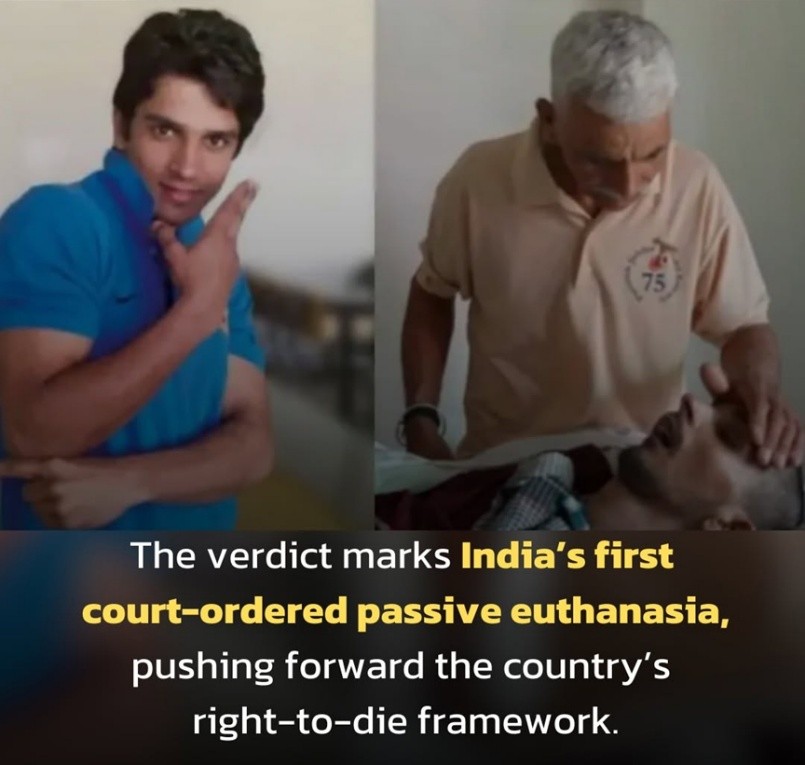
- The Supreme Court (SC) applies Passive Euthanasia framework for first time.
- The SC in Harish Rana vs Union of India judgement permitted the withdrawal of artificial life support of a man.
- It was on the basis of Best Interest of the Patient Principle
- He has been in a vegetative state for more than 12 years.
- The SC waived the usual 30-day consideration period as the patient’s parents and both medical boards unanimously agreed that recovery was impossible.
- It will be allowing the withdrawal of clinically assisted nutrition and hydration (CANH).
- This was the first time the Supreme Court had implemented its own 2018 Constitution Bench guidelines for what it had then called ‘passive euthanasia’.
- Euthanasia refers to the hastening of a patient’s death to relieve suffering.
- It is often referred to as mercy killing, typically occurring in cases where a patient suffers from an incurable or terminal distress.
- It is broadly classified into two types - Passive and Active.
- Under Passive euthanasia, a patient is allowed to die naturally by withholding or withdrawing medical treatment that sustains life.
- Therefore, it cannot be termed as the extinguishment of life or an unnatural termination of life.
- Consequently, the same is held not to fall foul of Article 21 (right to life and dignity).
- This is legal in India under strict guidelines.
- In P. Rathinam Case (1994), the SC initially held that the Right to Life includes the Right to Die, effectively de-criminalizing suicide.
- But, a Five-judge bench in Gian Kaur Case (1996), ruled that the Right to Life under Article 21 does not include the Right to Die.
- But it distinguished between dying unnaturally and dying with dignity.
- In Aruna Ramchandra Shanbaug case (2011), the SC rejected a plea for euthanasia, but allowed passive euthanasia under strict conditions for terminal and irreversible patients.
- The SC legalized Passive Euthanasia in India for the first time, subject to High Court approval.
- In Common cause judgment (2018), the SC recognised it and held that right to die with dignity is a fundamental right under Article 21.
- In 2018, a Constitution Bench of the apex court had upheld passive euthanasia and the right to give advance medical directives or ‘Living Wills’ to smooth the dying process as part of the fundamental right to live with dignity.
- The court had ruled that the fundamental right to life and dignity under Article 21 of the Constitution included the “right to die with dignity”.
- In 2026, in the present case, it laid down guidelines for it and recognised the concept of a 'living will'.
- Active euthanasia refers to the physician's deliberate act, usually the administration of lethal drugs, to end an incurably or terminally ill patient’s life.
- Active euthanasia is illegal in India.
- In its judgment, the apex court acknowledged the general consensus that ‘passive euthanasia’ was an obsolete and rather confusing term.
- ‘Euthanasia’ will refer strictly to active euthanasia, which remains impermissible.
- ‘Withdrawing or Withholding of Medical Treatment’ will replace the term ‘passive euthanasia’.
- The court held that withholding of life-sustaining interventions should not be a “single act” nor an “act of abandonment” of unconscious or incompetent patients in a persistent vegetative state (PVS).
- The process of withdrawal of CANH must be part of a well-structured, tailored, robust and articulated palliative care plan for a PVS patient in his or her most vulnerable phase of life.
- The right to die with dignity is inseparable from the right to receive quality palliative and End-of-Life (EOL) care.
- The court said any decision to withdraw or withhold medical treatment must withstand scrutiny on two primary grounds.
- The first is the intervention in question must qualify as ‘medical treatment’, and secondly, its withdrawal must strictly be in the patient’s “best interests”.
- It held that CANH qualified as medical treatment, even if done at home.
- Sound medical judgment and ethical considerations both are equally important while enquiring about whether withdrawal of life support is in the ‘best interest’ of the patient.
- The court directed Chief Medical Officers in all districts to form panels of registered medical practitioners to constitute secondary medical boards to examine applications for the withdrawal of life support.
- The area Judicial Magistrates of First Class must be intimated by hospitals if a primary and second medical boards unanimously recommend withdrawal of life support in cases.
- The distinction between “active” and “passive” euthanasia goes beyond the simplistic binary of “act” versus “omission”.
- Consequently, for active euthanasia to be legally permissible, there must be an explicit legislative enactment authorizing such deprivation.
In other countries
- Several European countries have legalized forms of assisted dying, primarily including Belgium, the Netherlands, Luxembourg, Spain, Austria, and Switzerland.
- Canada, Australia and New Zealand have all introduced assisted dying laws since 2015.
- As of mid-2025, assisted dying is illegal in the UK.
- But the House of Commons (Lower House) has passed a major bill, the "Terminally Ill Adults (End of Life) Bill".
- It aims to legalize it in England and Wales.
- In 2025, France has passed a law allowing terminally ill or gravely injured patients the right to die.
Leave a Reply
Your Comment is awaiting moderation.