

PREVIOUS
✖
Second Geothermal Well in Ladakh
July 25 , 2026
53 days
426
0
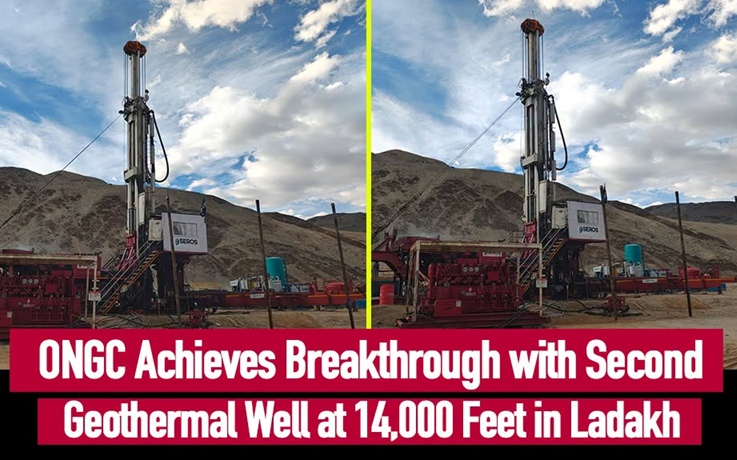
- Oil and Natural Gas Corporation (ONGC) drills a second geothermal well in Ladakh.
- It is India’s 1st pilot geothermal power plant with 1-Megawatt (MW) in Ladakh’s Puga Valley
- Thus, India's first and deepest geothermal wells were commissioned
- It aims to tap into underground steam and hot water to provide reliable, round-the-clock clean energy
- It successfully drilled to a depth of 1,000 meters, at an elevation of over 14,000 feet above sea level.
- It is one of the highest geothermal drilling projects in the world
- Puga Valley is geologically active - characterized by abundant hot springs, high underground thermal gradients, and shallow geothermal reservoirs.
- Manikaran, located in the Parvati Valley of Himachal Pradesh, is one of India's most prominent geothermal energy sites
- Natural hot springs emerge here at temperatures reaching 96° C.
- Geothermal energy is heat generated and stored deep within the Earth.
- It is originating from the planet's formation and radioactive decay, from the underground pools of steam and hot water trapped in hot spot region in earth crust.
- It provides a constant, reliable source of low-carbon, renewable power that operates independently of weather conditions like wind and solar.
- It aims to generate electricity and for other heating applications.
- Molten rocks formed in the deeper hot regions of earth’s crust are pushed upward and trapped in certain regions called ‘hot spots’.
- 4 Major potential regions - Northwest-Southeast Himalayan Arc, Gondwana Grabens and Delhi fold, West Coast continental margin, Son-Narmada-Tapti lineament

Leave a Reply
Your Comment is awaiting moderation.