

PREVIOUS
✖
State’s power to provide quota to Muslim converts
August 13 , 2026
71 days
498
0
- Tamil Nadu govt. defends State’s power to provide quota to Muslim converts from backward classes.
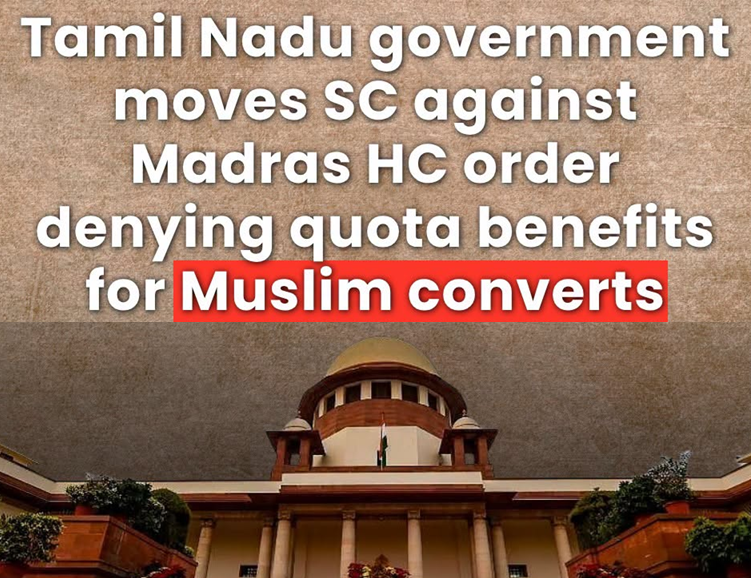
- The Supreme Court agreed to pronounce judgment on a Tamil Nadu government appeal seeking confirmation of the State’s power to frame and implement policy to provide reservation benefits to members of backward classes, most backward classes, Denotified communities and Scheduled Castes who convert to Islam.
- The object behind its government order of March 9, 2024 was to ensure that “persons belonging to socially and educationally backward communities are not deprived of reservation benefits solely on account of conversion to Islam and thereby create a level playing field by preserving affirmative action benefits despite change of religion”.
- The Madras High Court judgment of June 25 had held that “a person who embraces Islam cannot claim the status of backward class (Muslim)”.
- Justice Mishra orally observed that a 1951 judgment of the Madras High Court in G. Michael versus S. Venkateswaran, regarding a Scheduled Caste member who converted to Christianity and wanted to contest in a reserved seat, had held the fort for 75 years by upholding the constitutional validity of Paragraph 3 of the Constitution (Scheduled Castes) Order, 1950.
- Paragraph 3 of the 1950 order stipulated that no person who professed a religion different from Hinduism (later amended to include Sikhism and Buddhism) should be deemed to get the benefits of a Scheduled Caste member.
- The State, however, contended that the 1951 judgment did not disable the State from classifying a convert who was previously socially and educationally backward as a backward Muslim under Articles 15(4) and 16(4) of the Constitution.
- It said the March 24 order applied to the “wholly distinct category of backward class notification, which contains no religion-based exclusion”.
- The High Court had held that a Hindu, on conversion to Islam, did not carry forward the benefits of the Hindu caste or sub-caste.
- The convert’s status in Islam was not decided by the caste he was part of prior to the conversion.
- The High Court had noted that Christian missionaries as well as Islamic preachers maintained that their religions offered social equality unlike Hinduism, which had a caste hierarchy.

Leave a Reply
Your Comment is awaiting moderation.