

PREVIOUS
✖
Tamil Nadu Finance Data 2026–27
February 21 , 2026
241 days
27823
0
- The financial figures were presented in the Interim Budget Estimates 2026–27 of the Government of Tamil Nadu.
- The outstanding debt of Tamil Nadu is estimated at ₹10.71 lakh crore in the Interim Budget Estimates 2026–27.
- In the Revised Estimates 2025–26, it is ₹9.52 lakh crore, compared to ₹9.29 lakh crore in the Budget Estimates 2025–26.
- The debt figure includes ₹9,523 crore related to the approval of Chennai Metro Rail Limited Phase-II as a Central Sector Project, which will later reflect in the Union Government accounts.
- Excluding this amount, the outstanding debt is ₹9.42 lakh crore (Revised Estimates 2025–26) and ₹10.62 lakh crore (Interim Budget Estimates 2026–27).
- The State plans to borrow ₹1.79 lakh crore in 2026–27 and repay ₹60,413.42 crore during the same period.
- The debt-to-GSDP (Gross State Domestic Product) ratio is estimated at 26.12%.
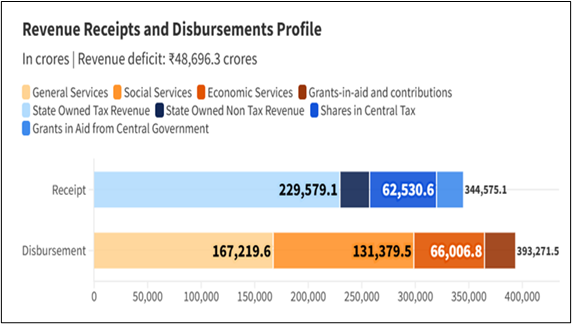
- The Revenue Deficit for 2026–27 is estimated at ₹48,696.32 crore.
- It was ₹69,219 crore in the Revised Estimates 2025–26 and ₹41,635 crore in the Budget Estimates 2025–26.
- The Fiscal Deficit for 2026–27 is estimated at ₹1.21 lakh crore, compared to ₹1.24 lakh crore in the Revised Estimates 2025–26.
- The Fiscal Deficit as a percentage of GSDP is expected to reduce from 3.48% (Revised Estimates 2025–26) to 3% (Interim Budget Estimates 2026–27).
- Since the 9th Finance Commission, Tamil Nadu’s share in central tax devolution has reduced from 7.9% to 4.079%, resulting in a loss of ₹3.17 lakh crore, which is about 33% of the State’s outstanding debt.
- In the 16th Finance Commission, Kerala and Karnataka received increases of 23.74% and 13.27% respectively, while Tamil Nadu received an increase of only 0.44%, the lowest among comparable States.

Leave a Reply
Your Comment is awaiting moderation.