

PREVIOUS
✖
Union Budget Numbers 2026
February 5 , 2026
241 days
932
0
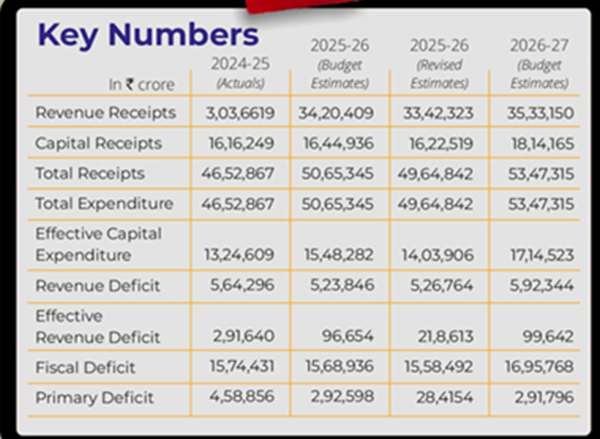
- Gross market borrowings for 2026-27 are estimated at ₹17.2 lakh crore, with net borrowings at ₹11.7 lakh crore.
- It was compared to ₹14.8 lakh crore in FY26 and is 16% higher than FY26 Budget Estimates.
- For FY26 itself, the bond market struggled to absorb ₹14.82 lakh crore of borrowings.
- The fiscal deficit is projected at 4.3% of GDP, slightly lower than 4.4% in 2025-26.
- Revenue deficit in 2026-27 is targeted at 1.5% of GDP.
- While the debt-to-GDP ratio is expected to ease to 55.6% in BE 2026-27, compared to 56.1 percent of GDP in RE 2025-26.
- For 2026-27, non-debt receipts are projected at ₹36.5 lakh crore and total expenditure at ₹53.5 lakh crore, with net tax receipts estimated at ₹28.7 lakh crore.
- In comparison, 2025-26 revised estimates placed non-debt receipts at ₹34 lakh crore and net tax receipts at ₹26.7 lakh crore.
- While total expenditure stood at ₹49.6 lakh crore, including around ₹11 lakh crore in capital spending.
- Borrowings and other liabilities form the largest source of funds for this Budget, accounting for 24% of total inflows, unchanged from the previous year.
- Income tax is the second-largest contributor at 21% (down from 22% last year), followed by GST and other taxes at 15%, compared with 18% in 2025-26.
- Corporation tax also makes up a significant share at 18%.
- The remaining budgetary resources come from non-tax revenue, Union excise duties, customs duties, and non-debt capital receipts.
- In the Budget, 22% of expenditure (unchanged from last year) is allocated to States’ share of taxes and duties, followed by interest payments at 20%.
- Interest payments account for 26% of the total expenditure, and 40% of revenue receipts.
- Central sector schemes account for 17% of total spending.
- Defence receives 11%, while Finance Commission and other transfers and centrally sponsored schemes get 8% and 7%, respectively.
- Pensions account for 2% of government expenditure, while the remaining 7% is spent on other items.
- The government has estimated a nominal GDP growth rate of 10% in 2026-27.

Leave a Reply
Your Comment is awaiting moderation.