

PREVIOUS
✖
16th Asiatic Lion Population Estimation 2026
August 14 , 2026
70 days
678
0
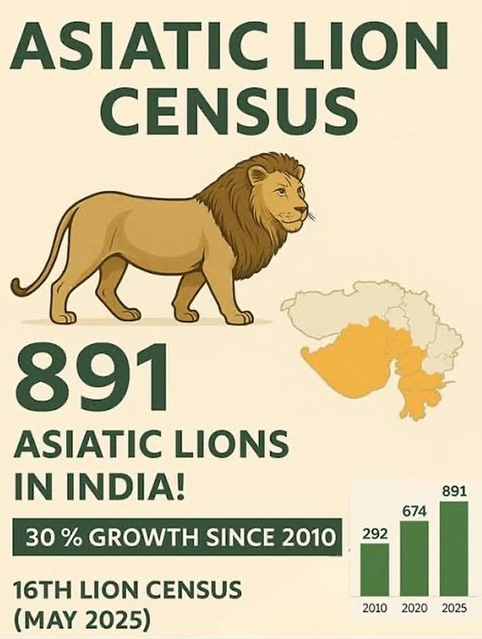
- The 16th Lion population estimation (May 2025) recorded an increase in the Asiatic Lion population to 891 individuals across the Greater Gir landscape in Gujarat.
- It is with a growth of 32 per cent rise from 674 lions since 2020.
- It has risen to 891 in 2025 from 523 in 2015.
- It is marking an increase of more than 70 per cent in a decade.
- Historically, the Asiatic lion inhabited regions across Asia, spanning from Persia and Mesopotamia to the Indian subcontinent.
- Only around 40-60 lions remained in and around Gir in the early 1900s because of overhunting and habitat loss.
- India established the Gir Wildlife Sanctuary in 1965.
- The princely State of Junagadh was among the first to protect the species.
- The Government attributed the increase to strict legal protection, revival of the lions’ prey base and a landscape-level conservation approach.
- Wild prey such as spotted deer, sambar, nilgai and wild pig now account for about 74 per cent of the lions’ diet.
- The return of lions to Barda Wildlife Sanctuary in Gujarat has been a notable part of the expansion.
- As numbers rose, lions expanded into new territories, which prompted the creation of further protected zones, including Gir National Park and wildlife sanctuaries such as Girnar, Mitiyala, Pania, and Barda.
- Community participation has also been central to the conservation effort.
- Project Lion, launched in 2020, now covers about 60,000 sq km of Saurashtra.
- The Asiatic lion is a subspecies of lion scientifically known as Panthera leo persica.
- The lion (Panthera leo) is a large, powerful apex predator and the second-largest big cat species in the world, second only to the tiger
- It’s only natural wild population survives in India, mainly in the Saurashtra region of Gujarat.
- The species is listed as Endangered on the IUCN Red List.
- The global list of seven big cats includes the Tiger, Lion, Leopard, Snow Leopard, Cheetah, Jaguar, and Puma.
- India is home to 5 of the 7 major big cat species recognized globally by the International Big Cat Alliance (IBCA), lacking only the Jaguar and the Puma.

Leave a Reply
Your Comment is awaiting moderation.