

PREVIOUS
✖
16th Finance Commission recommendations
February 6 , 2026
181 days
1669
0
Per Capita GSDP Distance (Income Distance)
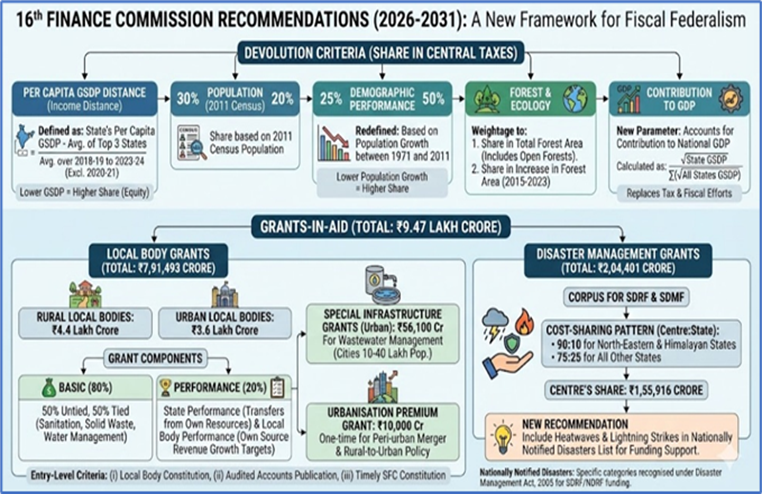
- The 16th FC has defined income distance as the difference between the per capita GSDP of a state and the average of the per capita GSDP of the top three large states with the highest per capita GSDP.
- Per capita GSDP has been computed as the average over the period 2018-19 and 2023-24, excluding the pandemic year of 2020-21.
- States with a lower per capita GSDP will receive a higher share on this parameter, to maintain equity among states.
Population
- On this parameter, the share in devolution is determined based on the share in the population as per the 2011 Census.
Demographic Performance
- The 15th FC had introduced this parameter to award states for controlling population on the basis of Total Fertility Rate (TFR).
- The 16th FC has redefined this to account for population growth between 1971 and 2011 instead of relying on change in TFR.
- States with lower population growth will have a higher share under this parameter.
Forest
- The 16th FC has assigned weightage to both the share of a state in the overall forest area, and its share in the increase in overall forest area between 2015 and 2023.
- Further, it has also considered open forests in arriving at the total forest area.
- In contrast, the 15th FC had considered only dense and moderately dense forests, and defined the parameter only in terms of share in the overall forest area.
Contribution to GDP
- The 16th FC has introduced this parameter to account for the contribution to national GDP.
- This replaces the tax and fiscal efforts parameter used by the 15th FC which rewarded states with a higher tax collection efficiency.
- Contribution to GDP by a state is calculated as the squared root of its GSDP to the sum of squared root of GSDP of all states.
- GSDP of each state has been measured as the average nominal GSDP between 2018-19 and 2023-24 (excluding the pandemic year of 2020-21).
Grants-in-aid
- The 16th FC has recommended grants worth Rs 9.47 lakh crore over the five-year period.
- These comprise grants for:
- Urban and rural local bodies, and
- Disaster management.
- The 16th FC has discontinued the following grants recommended by the 15th FC:
- Revenue deficit grants,
- Sector-specific grants, and
- State -specific grants.
Grants for local bodies
- The 16th FC has recommended grants worth Rs 4.4 lakh crore and Rs 3.6 lakh crore for rural and urban local bodies, respectively.
- Total Local Body Grants will be ₹7,91,493 crore
- These grants are divided into basic (80%) and performance-based (20%) components.
- Special Infrastructure Grants and Urbanisation Premium Grants have also been recommended for urban local bodies.
- All local body grants will be made available upon fulfilment of three entry-level criteria:
- Constitution of the local bodies as per the Constitution,
- Publication of provisional and audited accounts of the local bodies in the public domain, and
- Timely constitution of the State Finance Commission.
Basic grants
- 50% of the basic grant will be untied and the rest 50% will be tied to:
- Sanitation and solid waste management, and/or
- Water management.
Performance grants
- These grants for local bodies are further divided into state performance grants and local body performance grants.
- State performance grants will be made available upon meeting a minimum benchmark for transfers to local bodies from their own resources.
- Local body performance grants are linked to achievement of minimum targets specified by the Commission for own source revenue growth.
Special infrastructure grants
- This component will be tied to the development of a comprehensive wastewater management system in cities with population between 1040 lakh as per the 2011 census.
- Grants worth Rs 56,100 crore have been recommended over five years.
Urbanisation premium grant
- These will be released to states as a one-time grant for:
- Merger of peri-urban villages into adjoining urban local body areas and
- Formulation of a Rural to Urban Transition Policy. Rs 10,000 crore have been recommended under the urbanisation premium component.
Disaster management grants
- The Commission has recommended disaster management corpus of Rs 2,04,401 crore for State Disaster Relief and Management Funds (SDRF and SDMF).
- The cost-sharing pattern between the centre and states is recommended to be:
- 90:10 for north-eastern and Himalayan states, and
- 75:25 for all other states.
- Centre’s share in total will be Rs 1,55,916 crore.
- It has recommended that heatwaves and lightning strikes be included in India’s list of nationally notified disasters.
- Nationally Notified Disasters are specific disaster categories that are recognised under the Disaster Management Act, 2005.
- It is for the purpose of relief, response, and funding support from government disaster funds (State Disaster Response Fund (SDRF) and National Disaster Response Fund (NDRF))
- Currently it includes cyclones, droughts, earthquakes, fires, floods, tsunamis, hailstorms, landslides, avalanches, cloudbursts, pest infestations, frost and cold waves.

Leave a Reply
Your Comment is awaiting moderation.