

PREVIOUS
✖
Archaeological investigations in Tamil Nadu
February 3 , 2026
145 days
1455
0
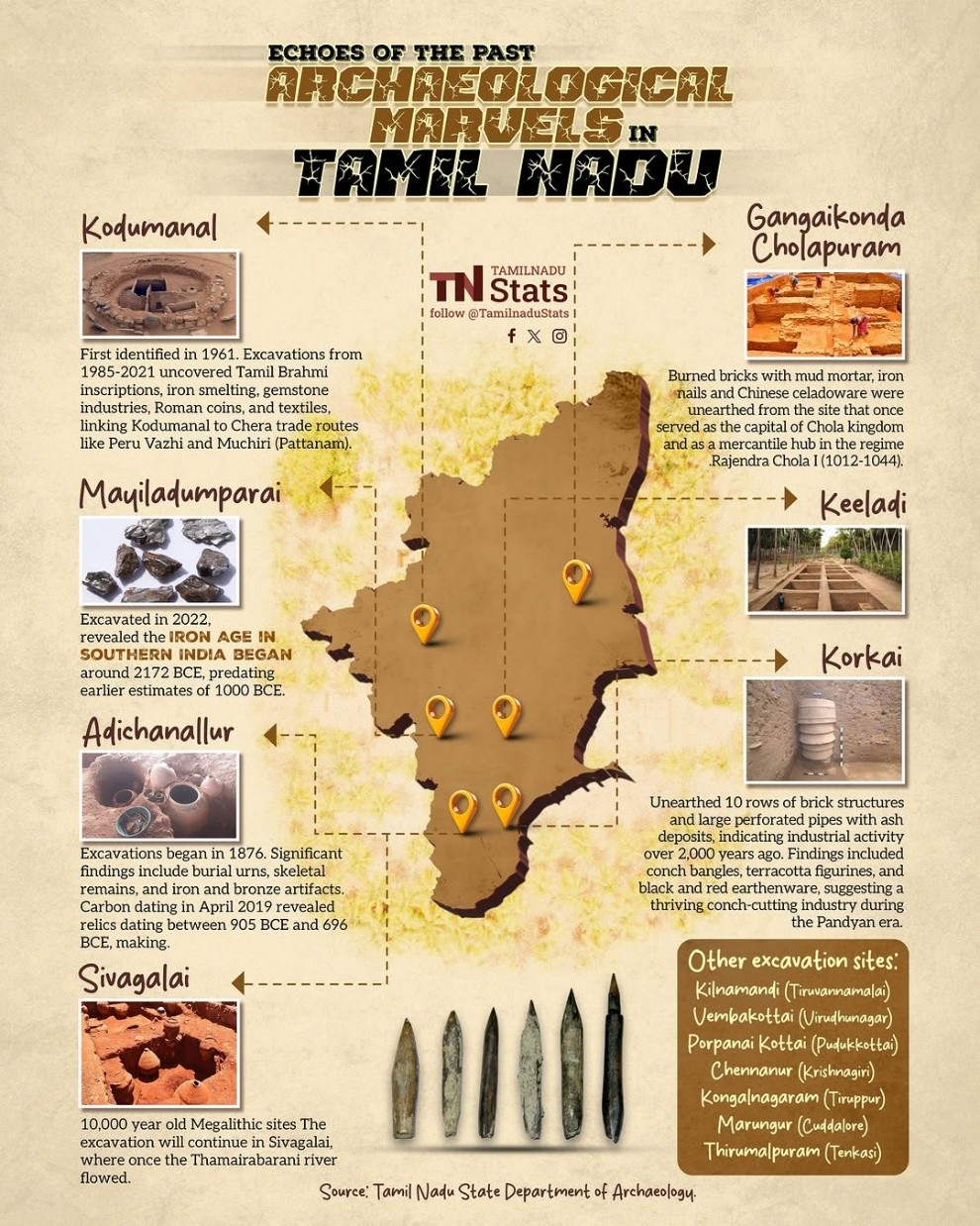
- Archaeological investigations have couched Tamil Nadu’s rich and diverse heritage within a broader perspective.
- This is in alignment with the argument of David Shulman, Indologist and author of “Tamil: A Biography”.
- Discoveries at Keeladi suggest that an urban and industrial civilisation once flourished there.
- Carbon dating of artefacts recovered from the site places them between the 6th century BCE and the 1st century CE.
- Excavations here revealed Sangam-age characteristics and continuity of brick structures.
- Accelerator Mass Spectrometry (AMS) dates from stratigraphical contexts show that Keeladi’s inhabitants were literate as early as the 6th century BCE and lived in an urban civilisation along the Vaigai river.
- The Tamil Nadu government has also established an open-air site museum at Keeladi, located at Kondagai in Sivagangai District.
- The museum features organised galleries with informative panels and curated archaeological exhibits in six thematic sections: Vaigai and Keeladi; Agrarian and Water Management; Ceramic Industries; Weaving and Beads; Sea Trade; and Lifestyle.
- The museum has structural remains and cultural layers of a Sangam-age urban settlement along the Vaigai river basin.
- Excavated features include aligned burnt-brick walls, rectangular brick tanks identified as dyeing vats, covered drainage made of terracotta pipes and bricks and terracotta ring wells used for water management.
- The Porunai Museum showcases artefacts obtained from the excavations at Sivagalai, Korkai, and Adichanallur.
- It is located at Reddiarpatti in Tirunelveli district.
- It also displays underwater finds, including shipwreck materials, lead ingots, and Roman pottery, pointing to ancient trade links with Rome, China, and Southeast Asia.
- The museum at Gangaikonda Cholapuram in Ariyalur district is being developed to preserve and present the historical and cultural heritage of the Imperial Chola dynasty.
- It is located near the Brihadeesvara Temple, a UNESCO World Heritage site.
- Gangaikonda Cholapuram was a city established by Rajendra Chola to mark his conquest of the north.
- Its Theme was Rajendra Chola I’s imperial legacy, maritime trade, and diplomacy.
- It will display brick remains from the royal palace at Maligaimedu, war trophies, stone sculptures, inscriptions, architectural fragments, and archaeological artefacts from the region.
- Construction of the Grand Chola Museum is under way to establish the museum on the campus of Tamil University in Thanjavur.
- It will foreground the historical significance of the Chola dynasty.
- A centrepiece of the museum will be a 125-foot-tall statue of the Chola emperor Raja Raja Chola I.
- Naavai Museum’s location will be Mandapam in Ramanathapuram district.
- Its theme will be Materials excavated at Alagankulam.
- Naavai means a large ship in ancient Tamil.
- The Chola conquest of the seas in the later period stands as clear evidence of a sustained naval policy pursued by Chola monarchs.
- Historian K.A. Nilakanta Sastri notes that the early Cholas of the Sangam age also played a significant role in maritime trade and seafaring activity in the Indian seas.
- The Pandyas, too, excelled in maritime commerce.
- The historical basis for this lies in the extensive archaeological finds from Alagankulam.
- It was an ancient port located at the confluence of the Vaigai River and the Bay of Bengal.
- Between the 2nd century BCE and the 5th century CE, the port functioned as a major Pandya trade hub, linking South India with Rome, Egypt, and Southeast Asia.
- Among the most striking exhibits will be the ‘ship graffito’ — a rare potsherd bearing the incised image of a three-masted sailing vessel — offering material evidence of advanced seafaring traditions.
- More than 13,000 antiquities recovered from the site, including Roman amphorae, Arretine ware, and a cross-inscribed seal, point to a cosmopolitan trading settlement with far-reaching connections.
- Noyyal Museum is located at Perundurai in the Erode district.
- Its theme will be the Materials excavated at Kodumanal.
- Kodumanal was referred to as Kodumanam in the Padhitrupathu of Sangam literature.
- Situated on the northern bank of the Noyyal River, Kodumanal functioned as a multi-industrial settlement between the 5th century BCE and the 3rd century CE.
- The site was a major centre for the production of semi-precious stone beads, with thousands of beads made of beryl, carnelian, agate, quartz, lapis lazuli, and sapphire.
- While beryl was sourced locally from nearby Padiyur, lapis lazuli originated in Afghanistan, pointing to extensive long-distance trade networks.
- Kodumanal has also yielded one of the largest collections of Tamil-Brahmi inscribed potsherds in Tamil Nadu.
- In addition, the museum will present the region’s megalithic burial culture, including menhirs and cist burials furnished with rich grave goods such as carnelian beads and iron swords.
- Known in ancient literature as Thirukadalmallai, Mamallapuram — the ancient port city of the Tamil country — has, for centuries, stood as a powerful symbol of maritime strength.
- Flourishing from the Sangam age and reaching its architectural zenith under the Pallavas between the 6th and 9th centuries CE, it functioned not merely as a centre of trade and travel but as a vital bridge linking the Tamil region with distant civilisations in Sri Lanka, Southeast Asia, and beyond.
- The museum will be established at the Beach Resort Complex on the East Coast Road (ECR), owned by the Tamil Nadu Tourism Development Corporation.
- The State government has proposed the establishment of the Dharmapuri Museum at Adhiyaman Kottai in the Dharmapuri district, with the theme of hero stones.
- The hero stone serves as an important archaeological artefact, providing insight into the social, historical, and artistic practices of ancient Tamil communities.
- The ongoing construction of the Courtallam Museum at Courtallam in the Tenkasi district will feature excavated materials from Tirumalapuram and Rajakalmangalam.
- Other proposed museums include the Tamil Cultural Museum at Tiruvannamalai and the Indus Gallery Museum in Egmore, Chennai.
Leave a Reply
Your Comment is awaiting moderation.