

PREVIOUS
✖
Economic Survey on Tamil Nadu schemes
February 5 , 2026
59 days
532
0
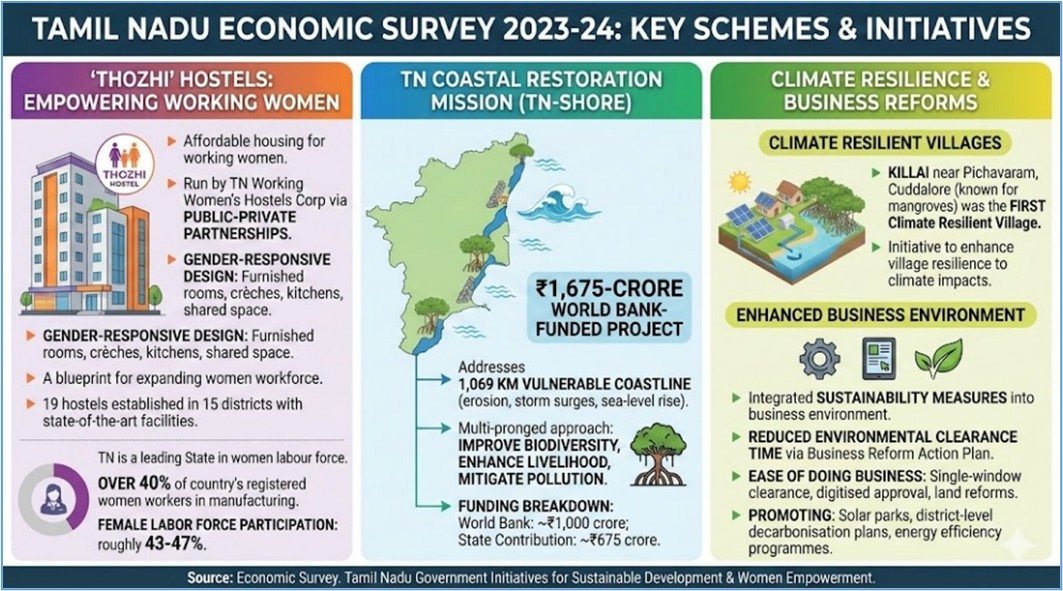
- The Economic Survey highlighted Tamil Nadu’s ‘Thozhi’ hostels for working women.
- ‘Thozhi’ working women’s hostels provide affordable housing to working women.
- These hostels are run by the Tamil Nadu Working Women’s Hostels Corporation through public-private partnerships.
- These are equipped with gender-responsive design, furnished rooms, crèches, kitchens, and shared space.
- They offer a practical blueprint for States seeking to expand women workforce.
- Tamil Nadu is a leading State in India in terms of women labour force.
- It has over 40% of the country's registered women workers in manufacturing.
- It has a female labor force participation rate of roughly 43-47%.
- So far, 19 ‘Thozhi’ hostels, equipped with state-of-the-art facilities, have been established in 15 districts.
- The survey notes that Tamil Nadu has a coastline of 1,069 kilometres across 14 districts that are vulnerable to shoreline erosion, storm surges, and sea-level rise.
- The Tamil Nadu Coastal Restoration Mission (TN-SHORE) employs a multi-pronged approach to improve coastal biodiversity and protection, enhance livelihood, and mitigate pollution.
- TN-SHORE is a ₹1,675-crore World Bank-funded project.
- Of the total investment, around ₹1,000 crore will come from the World Bank and the State will contribute the rest.
- The survey also highlights Climate Resilient Villages, an initiative taken up in Tamil Nadu and in a few other States.
- In Tamil Nadu, Killai near Pichavaram in Cuddalore district, known for its vast mangrove forests, was the first Climate Resilient Village.
- Tamil Nadu is among the few States that have not only enhanced their business environment by integrating sustainability measures.
- It has also reduced the time taken for environmental clearance through the Business Reform Action Plan.
- Tamil Nadu has enhanced the ease of doing business through single-window clearance, digitised approval, and land reforms, while promoting solar parks, district-level decarbonisation plans, and energy efficiency programmes.

Leave a Reply
Your Comment is awaiting moderation.