

PREVIOUS
✖
GOBARdhan scheme
August 13 , 2026
71 days
575
0
- GOBARdhan means Galvanising Organic Bio-Agro Resources Dhan.
- It is India’s National Unified Scheme for Compressed Biogas.
- It is the National Circular Bioenergy Scheme, with a total outlay of Rs.23,731 crore, to be in place until 2036.
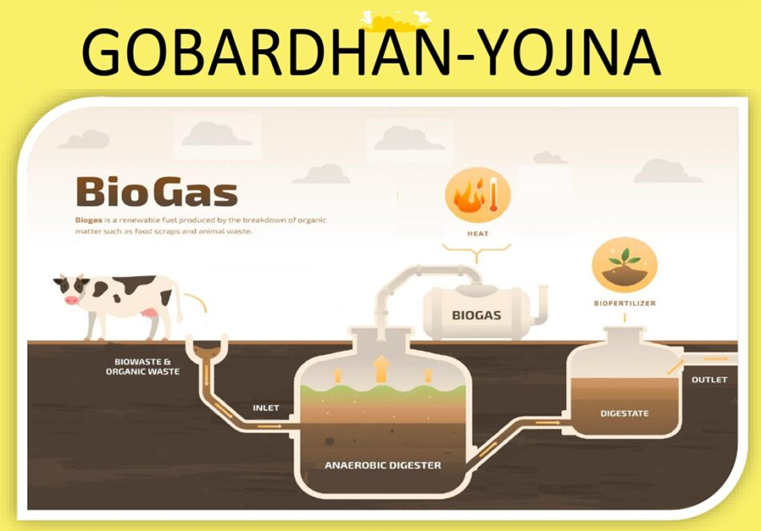
- GOBARdhan is an integral component of Solid Waste Management (SWM) under Phase II of Swachh Bharat Mission (Grameen) for ensuring cleanliness in villages by converting cattle dung, kitchen leftovers, etc. into biogas and bio-slurry.
- It is coordinated primarily by the Department of Drinking Water and Sanitation (DDWS) under the Ministry of Jal Shakti as part of the Swachh Bharat Mission (Grameen).
- However, as an expanded national initiative emphasizing compressed biogas (CBG) and waste-to-wealth, it operates on a whole-of-government approach coordinated closely with the Ministry of Petroleum and Natural Gas (MoPNG) alongside other ministries like New and Renewable Energy and Agriculture.
- Swachh Bharat Mission Grameen (SBM-G) Phase-II is a Centrally Sponsored Scheme.
- The scheme aspires to increase domestic production of CBG ten-fold and mobilise large-scale private investment.
- It will transform the country’s abundant agricultural residue, cattle dung, press mud, municipal organic waste and other biomass resources into clean fuel, organic manure, rural income and national economic value.
- It will establish Compressed Biogas as a major pillar of India’s future energy mix.
- It seeks to increase domestic compressed biogas production nearly ten-fold through assured offtake, administered pricing, capital subsidies, pipeline infrastructure and easier access to finance.
- The scheme addresses three imperatives -- remunerative price, assured offtake and capital support -- sought by the industry.
- One of the most critical components is the development of the necessary pipeline infrastructure, which is essential for the widespread adoption of CBG, as it ensures reliable offtake and enables seamless integration with the broader gas grid.
- GOBARdhan further introduces a stable-administered price of ₹2,110 per Metric Million British Thermal Unit (MMBTU) for CBG.
- It reflects the Government’s commitment to energy security, farmers and rural enterprises, waste-to-wealth, Atmanirbhar Bharat and the vision of Viksit Bharat.
- Nearly ten-fold growth in domestic CBG production, creating a new pillar of India’s clean gas economy.
- Greater energy security through increased domestic production of renewable gaseous fuel and lower dependence on imported fossil fuels.
- A new wave of private investment supported by stronger project viability, stable pricing and improved access to institutional finance.
- Stronger rural livelihoods through new income opportunities for farmers, feedstock aggregators, cooperatives and rural entrepreneurs.
- Scientific waste management through productive use of agricultural residue, cattle dung, municipal organic waste and other biomass resources.
- Lower greenhouse gas emissions through replacement of fossil fuels and productive utilization of organic waste.
- A larger organic manure economy through greater production, value addition and utilization of FOM and LFOM.
- Faster and easier project implementation through one national framework, digital governance and simplified institutional arrangements.

Leave a Reply
Your Comment is awaiting moderation.