

PREVIOUS
✖
Great Indian Bustard Conservation Status
July 24 , 2026
58 days
352
0
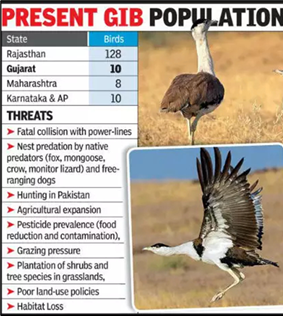
- The latest assessment by the Wildlife Institute of India (WII) reported that the population of the Great Indian Bustard (Ardeotis nigriceps) remains stable at around 110–150 birds.
- The Great Indian Bustard, listed as Critically Endangered on the IUCN Red List, is now restricted to only 16% of its potential habitat in Rajasthan’s Thar Desert.
- The survey recorded around 130 Great Indian Bustards (±21 variation) along with 35 GIB flocks, 1,568 Chinkara herds and 79 Desert foxes.
- Major threats include habitat fragmentation, agricultural expansion, poaching, egg predation and collisions with power transmission lines.
- Conservation measures include Project Great Indian Bustard, captive breeding at Sam and Ramdevra centres, habitat improvement and power line management as directed by the Supreme Court.

Leave a Reply
Your Comment is awaiting moderation.