

PREVIOUS
✖
Women's Conditions in Tamil Nadu
February 21 , 2026
187 days
1928
0
- The Economic Survey 2025–26 of the State Planning Commission (SPC) highlights data on women’s social and economic conditions in Tamil Nadu.
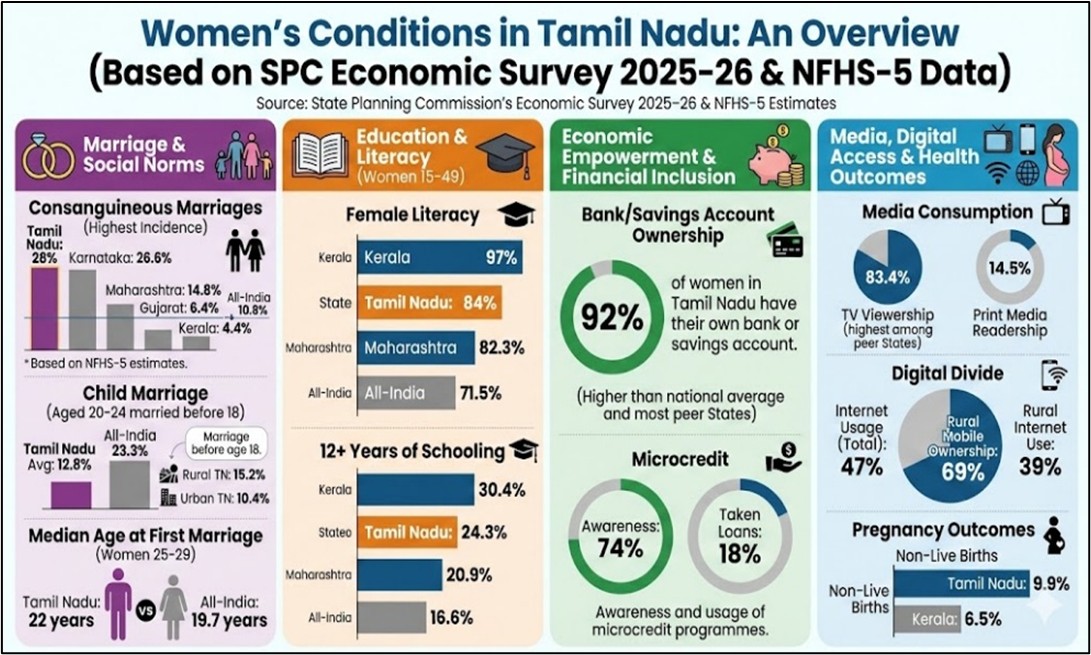
- Tamil Nadu reports the highest incidence of consanguineous marriages among peer States at 28%, according to estimates based on the National Family Health Survey-5 (NFHS-5).
- The all-India average is 10.8%, followed by Karnataka (26.6%), Maharashtra (14.8%), Gujarat (6.4%), and Kerala (4.4%).
- Child marriage is any marriage where a person is under 18 years old.
- In Tamil Nadu, 15.2% of women in rural areas and 10.4% in urban areas were married before 18, making the State average 12.8%, compared to the all-India average of 23.3%.
- The median age at first marriage for women aged 25–29 in Tamil Nadu is 22 years, which is higher than the all-India median of 19.7 years.
- Female literacy (women aged 15–49) in Tamil Nadu is 84%, and 24.3% of women have completed 12 or more years of schooling.
- Only Kerala has higher figures (97% literacy and 30.4% schooling), while Maharashtra follows Tamil Nadu with 82.3% literacy and 20.9% schooling.
- The all-India averages are 71.5% literacy and 16.6% schooling.
- About 92% of women in Tamil Nadu have their own bank or savings account, which is higher than the national average and most peer States.
- Awareness of microcredit programmes is 74%, and 18% of women report taking loans from them.
- Tamil Nadu has the highest television viewership among peer States (83.4%), but print media readership among women is only 14.5%.
- About 47% of women use the internet, and the rural–urban digital divide is visible, as 69% of rural women own a mobile phone and only 39% use the internet.
- Tamil Nadu reports the highest proportion of pregnancies ending in non-live births at 9.9%, compared to 6.5% in Kerala.

Leave a Reply
Your Comment is awaiting moderation.